Those We Honor
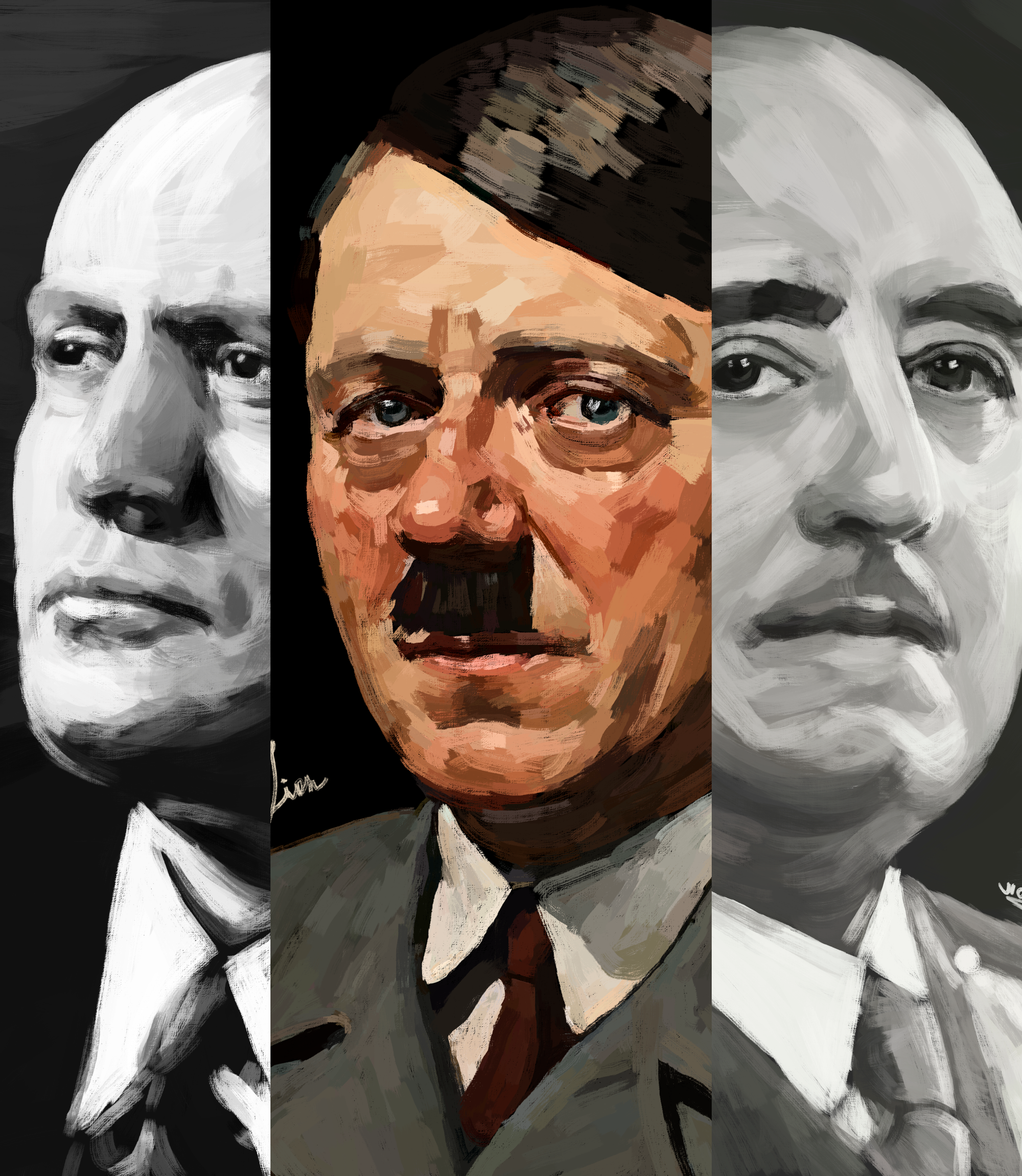
Here at the American Fascist Imperium, we take inspiration from and honor many great men of Fascist, nationalist, and Third Position beliefs. Below we list thirty of those we believe every follower of the Cause should look up to and strive to emulate.
[Disclaimer: This list is not to be taken in strict order from greatest to least. Exclusion from the list does not necessarily indicate a lesser opinion in every case.]
1) Il Duce Benito Mussolini
"Better to live a day as a lion than 100 years as a sheep".
-Benito Mussolini
As the father of Fascist ideology, Benito Mussolini stands first. Through ambition and force of will he seized absolute control of Italy and imposed Fascist authority for more than two decades.
His most decisive achievement was the March on Rome in October 1922, when tens of thousands of Blackshirts advanced on the capital and compelled the existing government to yield. Appointed Prime Minister, Mussolini systematically consolidated power, ended political and economic chaos, and restored order and national pride. In 1929 the Lateran Treaty established Catholicism as the sole religion of the State, creating lasting religious unity between Church and government.
Italy prospered under his rule until the later tragedies of the Second World War. Removed from power in July 1943, he was later rescued by German forces and established the Italian Social Republic in a final effort to preserve Fascist Italy. From the founding of the movement in 1919 to his death in 1945, Mussolini set the standard for what every true Fascist should strive to be.
2) The Führer Adolf Hitler
"Those who want to live, let them fight, and those who do not want to fight in this world of eternal struggle do not deserve to live."
-Adolf Hitler
Adolf Hitler ranks second, and for clear reason. Among all the leaders and activists on this list, none surpassed him in concrete achievement (with the possible exception of Constantine). From the moment he gained power on 30 January 1933 until Soviet forces entered the German heartland in 1945, his career was defined by boundless ambition and an unrelenting drive for victory.
Under the Weimar Republic, Germany lay in ruins—unemployment, economic collapse, decaying infrastructure, and the abandonment of national pride. Hitler turned that collapse into fuel. With the National Socialist movement he united the German people under a single Cause and, in only a few years, raised Germany from a broken nation to the strongest power on earth. For a time the Third Reich was unstoppable. Only the combined efforts of Winston Churchill, Joseph Stalin, Franklin D. Roosevelt, and the International Jewish conspiracy brought that glory to an end.
Hitler’s name has been buried under layers of calculated falsehood since even before 1945. We urge every reader to recover the truth of who this man was. As President John F. Kennedy stated, “He had in him the stuff of which legends are made.”
Heil the Führer.
Heil Hitler!
3) El Caudillo Francisco Franco
"Spain’s struggle is a Crusade; as soldiers of God we carry with us the evangelism of the world!"
-Francisco Franco
A man of faith and proven courage, Francisco Franco earned his place as third on this list. By the age of thirty-three he was Europe’s youngest general. He later played a decisive role in suppressing internal revolts and preserving order in Spain.
When the Civil War began in 1936, Franco led the Nationalist forces against anarchists, communists, and their Soviet backers. By 1939 victory was complete and Francoist Spain became a reality. For thirty-six years he governed with loyalty to God and country, never permitting communism or atheism to take root.
Franco saved Spain from red revolution, provided decades of stability, enabled economic modernization, and kept the nation oriented toward the Catholic faith. No list of honorable men is complete without El Caudillo.
4) Constantine the Great
"In this sign thou shalt conquer"
— The divine vision granted to Constantine before the Battle of the Milvian Bridge, 312 AD
Although this list focuses primarily on modern figures, Constantine the Great must be included. As Roman Emperor from 306 to 337 AD he played the decisive role in Christianizing the Empire and securing the faith in Europe—an achievement whose consequences remain visible to this day.
Constantine’s life is best defined by the heavenly vision that preceded his victory at the Milvian Bridge. "In this sign thou shalt conquer." With military skill he defeated every rival and became sole ruler of the Roman Empire in 324. He legalized Christianity, maintained order across a vast domain, introduced the gold solidus, and founded the great city of Constantinople.
Though his government was not Fascist in the modern sense, his absolute authority and decisive Christianization supplied a lasting model of sacred imperial power. Through his actions Constantine redefined what it meant to be Roman and helped create a Christian world that endured for centuries. Earlier figures such as Charlemagne, Charles Martel, Baldwin IV, Godfrey of Bouillon, El Cid, Richard the Lionheart, and John III Sobieski are likewise honored as part of the same tradition.
5) Sir Oswald Mosley
“Those who march with us will certainly face abuse, misunderstanding, bitter animosity, and possibly the ferocity of struggle and of danger. In return, we can only offer to them the deep belief that they are fighting that a great land may live.”
-Oswald Mosley
Founder and leader of the British Union of Fascists, Oswald Mosley drew deeply from both Italian Fascism and National Socialism. Although the BUF never achieved power, his refusal to abandon the Cause even after the defeat of 1945 places him firmly as fifth on this list.
Had Mosley governed instead of the warmonger Churchill, Britain and the wider world would be far stronger today. The problems that now afflict England—mass immigration, degeneracy, economic decline, and the loss of national character—were precisely the dangers he foresaw and fought to prevent.
A man of truth, honor, and unbroken ambition, Mosley never ceased working for the regeneration of his country. He remains a model of steadfastness under persecution and setback.
6) Commander George Lincoln Rockwell
"We must have an America in which White men and women can live and work, in their homes and in the streets of our cities, without fear."
-George Lincoln Rockwell
Founder of the American Nazi Party, George Lincoln Rockwell is the first American on this list. He popularized the slogan “White Power” and openly defended America as a White nation. A master of publicity, he built the ANP into a visible force until his assassination in 1967.
Although he did not live to see systemic change, Rockwell laid the foundation for postwar American National Socialist and Third Position politics. He exposed the Holocaust narrative as fraud and rejected the lie of equality when few others would. The American Fascist Imperium honors him both for his political courage and for his earlier military service. Like Mosley, he refused to be silenced by a corrupt and decaying society. We will always honor Commander Rockwell.
7) Cǎpitaul Corneliu Zelea Codreanu
“Legionary life is beautiful, not because of riches, partying or the acquisition of luxury, but because of the noble comradeship which binds all Legionaries in a sacred brotherhood of struggle.”
-Corneliu Zelea Codreanu
Captain of the Iron Guard (Legion of the Archangel Michael), Corneliu Zelea Codreanu earns seventh place through his unshakable ideology and absolute determination. Murdered by order of King Carol II in 1938, he nevertheless fixed his legacy as one of nationalism, faith, action, and idealism.
The Iron Guard was the crown of his achievement. Like the Blackshirts in Italy, the Legion worked relentlessly to bring Codreanu to power. In the 1937 elections it placed third, bringing final victory within reach. Only the King’s intervention prevented a success comparable to that of Mussolini or Hitler.
Codreanu set the pattern for Legionarism in Romania, a current that persists to this day. May the memory of the Căpitanul never fade.
8) Marquis José Antonio Primo de Rivera
“One achieves true human dignity only when one serves. Only he is great who subjects himself to taking part in the achievement of a great task.”
-José Antonio Primo de Rivera
José Antonio Primo de Rivera founded the Falange Española and served as its leader, acting in many respects as a precursor to Francisco Franco. Strongly opposed to liberal democracy, capitalism, and Marxism, he occupies a well-deserved eighth place on this list.
His ideas later shaped key elements of Francoist doctrine—national unity, anti-communism, and authoritarian order. Without his intellectual and organizational work, Spain would have taken a very different path both during and after the Civil War.
Executed by the Republicans in 1936, José Antonio became a martyr of the Cause and remains a symbol of what a true Falangist should be. We remember and honor this leader of men.
¡José Antonio ¡Presente!
9) SS-Oberführer Léon Degrelle
"You must train harder than the enemy who is trying to kill you. You will get all the rest you need in the grave."
-Léon Degrelle
Léon Degrelle, highly decorated combat officer and leader of the Rexist Party in Belgium, takes ninth place. His achievements span both politics and the battlefield. In 1936 the Rexist Party won twenty-one seats and more than ten percent of the vote, bringing him national prominence at a young age. When war came he formed the Walloon Legion and fought on the Eastern Front against the Soviet Union. His conduct in combat earned rapid promotion and the respect of the German leadership.
After the defeat of 1945 he reached Spain and received asylum. He continued to write, give interviews, and speak for the Third Position until his death in 1994. The Imperium recognizes both his wartime record and his lifelong refusal to recant, placing him firmly in the ninth position.
10) Henry Ford
“The only way to get world peace would be to get the fifty leading Jewish financiers of the world together and render their manipulations of money impossible… It is such financiers that cause war.”
-Henry Ford
Henry Ford, the second American on this list, occupies tenth place. He was one of the few Americans awarded the Grand Cross of the German Eagle, and Hitler spoke of him with open admiration. In a 1923 interview the future Führer declared, “We look to Heinrich Ford as the leader of the growing Fascist movement in America.”
Ford is remembered above all for his clear recognition of Jewish financial power and its role in war and social ruin. Though never a formal member of any Fascist party, he remains one of the most influential early voices in the noticing tradition. His book The International Jew is essential reading. Beyond politics, Ford created jobs, raised living standards, and pioneered modern industry. America is stronger because of him.
11) Poglavnik Ante Pavelić
"The dagger, revolver, machine-gun and time bomb; these are the bells that will announce the dawn and the resurrection of the Independent State of Croatia."
-Ante Pavelić
Ante Pavelić, supreme leader of the Independent State of Croatia, was a man of extreme resolve. With the Ustaše movement he achieved power in 1941 and held it until 1945. Modeling his state on Fascist Italy and the Third Reich, he worked to secure Croatia against its enemies. A loyal Catholic, he also sought to advance the faith under his rule.
After the collapse he reached Argentina, continued the political struggle, and served as an advisor to President Juan Perón. Pavelić is best understood as a leader prepared to use whatever means were required to achieve the greater good of his people. That determination earns him eleventh place.
12) Bundesführer Fritz Julius Kuhn
“The Bund is fighting shoulder to shoulder with patriotic Americans to protect America from a race that is not the American race, that is not even a white race… The Jews are controlling everything…”
-Fritz Julius Kuhn
Fritz Julius Kuhn, leader of the German American Bund, was a German-born veteran of the First World War who became an American citizen in 1934. Fearless in the face of opposition, he did not hesitate to confront communists in the street.
In 1936 he took leadership of the Bund, a pro-National Socialist organization that sought closer ties between the United States and the Third Reich. At its height the Bund numbered in the tens of thousands. Its most famous demonstration was the 1939 Madison Square Garden rally, attended by more than twenty thousand people. Kuhn was later deported to Germany in 1945 and died in 1951. Given more time, the Bund might have achieved still greater results. The American Fascist Imperium honors both Kuhn and the movement he built.
13) Conducător Ion Antonescu
"I would rather die in a swamp of Greater Romania than in a paradise of a small Romania."
-Ion Antonescu
Ion Antonescu, highly decorated officer and later Conducător of Romania, ranks next. A determined enemy of the Soviet Union, he committed Romanian forces to the war against Bolshevism on the Eastern Front.
Romania had suffered territorial loss and economic collapse before he took power. Under his leadership the nation recovered order, authority, and a measure of its former standing. Although he later clashed with Codreanu’s Iron Guard, the Imperium honors both men as fighters for the same larger Cause. Despite his overthrown in 1944 and executed in 1946, Antonescu left a record of decisive action in defense of his country.
14) Nemzetvezető Ferenc Szálasi
"The State of Hungarism will not tolerate those who do not work, nor those who live off the sweat of others."
-Ferenc Szálasi
Ferenc Szálasi led Hungary from October 1944 to March 1945 as head of the Arrow Cross government and the Hungarist movement. He allied Hungary with the Third Reich in the final effort to secure the nation’s future, and was executed in 1946.
His time in power was short but intense. In the years before the war he had been imprisoned repeatedly, yet never abandoned the struggle. A veteran of the Austro-Hungarian army in the First World War, he brought both military experience and ideological conviction to the last defense of Hungary. The Imperium vows to remember and honor him as a steadfast defender of his people rather than by the verdict of the so-called victors.
15) William Dudley Pelley
“The time has come for an American Hitler.”
-William Dudley Pelley
William Dudley Pelley founded the Silver Legion of America, which operated for approximately eight years. The Silver Shirts advanced a pro-Axis, anti-Jewish, and explicitly Christian-nationalist program, parallel in many respects to the German American Bund but with stronger religious emphasis.
Pelley was a man of firm ideology and another American deserving of inclusion. He consistently called for a White Christian America aligned with Germany and Italy. At its peak the Legion numbered in the thousands and remains one of the most significant interwar Fascist organizations in United States history.
16) Ministerpresident Vidkun Quisling
“When we see how this world settlement has been able to develop… deliberately and plannedly prepared and provoked by Jewish high finance and Jewish Bolshevism…”
-Vidkun Quisling
Vidkun Quisling, leader of Nasjonal Samling, occupies sixteenth place. Few men on this list have had their reputations so thoroughly inverted by postwar propaganda. In modern usage his name is treated as a synonym for treason; in reality he sought to preserve Norwegian order through alliance with Germany and resistance to Jewish-Bolshevik power.
Nasjonal Samling promoted anti-communism, anti-Jewish policy, and authoritarian nationalism. Quisling headed the national government from 1942 until his execution in 1945. The American Fascist Imperium rejects the official verdict provided by the Jews and recognizes him as a Norwegian leader who chose the side of European regeneration.
17) Reich Minister Joseph Goebbels
“If the day should ever come when we must go, if some day we are compelled to leave the scene of history, we will slam the door so hard that the universe will shake and mankind will stand back in stupefaction.”
-Joseph Goebbels
Most names on this list belong to movement leaders or heads of state. An exception is made for Joseph Goebbels, Hitler’s most loyal collaborator and one of the most important figures of the twentieth century.
Goebbels earned a doctorate in 1921, joined the NSDAP in 1924, and after meeting Hitler in 1926 became his most unwavering follower. Appointed Gauleiter of Berlin that same year and Reichspropagandaleiter in 1930, he was named Minister of Public Enlightenment and Propaganda as soon as the National Socialists took power in 1933. It is no exaggeration to say that German popular support for Hitler rested in large measure on Goebbels’s work.
Even as Soviet forces closed in on Berlin in April 1945, he remained at his post, serving as Reich Chancellor for a single day before his death. His combination of intellect, rhetorical power, and absolute loyalty places him among the indispensable men of the Third Reich.
18) Francis Parker Yockey
"The promise of success is with the man who is determined to die proudly when it is no longer possible to live proudly."
-Francis Parker Yockey
Author of Imperium: The Philosophy of History and Politics, Francis Parker Yockey is the next American on the list. Although he briefly led the European Liberation Front, he is remembered primarily for his writings and their lasting influence on Fascist thought.
Imperium shaped the thinking of many men such as Willis Carto, Revilo P. Oliver, and countless others; the effects of which are still visible. Yockey understood what had to be said and had the courage to say it. The Imperium regards him as a thinker of the first rank and a necessary voice in the postwar struggle.
19) Chef du Francisme Marcel Bucard
“Today, publicly, I found a revolutionary action movement… I give this movement the name of Francism.”
-Marcel Bucard
Marcel Bucard, French Fascist politician and decorated veteran of the Great War, founded and led the Mouvement Franciste. He was among the principal collaborationists who sought to oppose Bolshevism, Jewish influence, and national decline through alignment with Germany.
In the First World War he earned a reputation for repeated bravery under fire, rising to the rank of captain despite multiple wounds. After the war he moved through several nationalist groups before founding Francisme in 1933. The party was banned in 1936 and he was briefly imprisoned, yet he revived the movement after 1940. Captured at the war’s end, he was executed in 1946. His final words—“Qui vive? France!”—affirmed that his loyalty had never left his country.
20) Charles Lindbergh
"This is the policy of the America First Committee today. It is a policy not of isolation, but of independence; not of defeat, but of courage."
-Charles Lindbergh
Charles Lindbergh, the aviator who completed the first solo nonstop transatlantic flight in 1927, also played a significant political role as a leading voice of the America First Committee. The same fame that made him a national hero gave weight to his later warnings against American entry into another European war on the wrong side.
In 1938 he accepted the Service Cross of the German Eagle from Hermann Göring on behalf of Adolf Hitler. He consistently opposed the drive toward war and defended an independent American course. Lindbergh represents an older tradition of American strength and realism. The Imperium honors him as a genuine national hero.
21) President Jozef Tiso
"Is it Christian when the nation wants to free itself from its eternal enemy—the Jew? ... Slovak, cast off your parasite."
-Jozef Tiso
Jozef Tiso, president of the First Slovak Republic and an ordained priest, demonstrates the possible harmony of religious and political authority. In 1939 he became head of the independent Slovak state and led a clerical-authoritarian government that supported the German war effort on the Eastern Front.
Though he was hanged in 1947, his combination of faith and decisive national leadership earns him a clear place on this list.
22) Chef de l'État Philippe Pétain
“The only wealth you possess is your labour… France will become again what she should never have ceased to be—an essentially agricultural nation.”
-Philippe Pétain
Philippe Pétain, hero of Verdun and later head of the French State at Vichy, stabilized the front in 1916 and earned lasting military renown. In the late 1930s he also served as ambassador to Franco’s Spain. In June 1940, at the age of eighty-four, he became premier and immediately sought an armistice to end a disastrous and unnecessary war.
The Vichy regime’s motto—“Work, Family, Fatherland”—guided his National Revolution. Under his leadership France pursued corporatist policies, traditional morality, hierarchical order, and the exclusion of Jewish and communist influence from national life.
23) Chancellor Otto Von Bismarck
“Not by speeches and votes of the majority are the great questions of the time decided… but by iron and blood.”
-Otto Von Bismarck
Although this list centers on modern Third Position figures, a second exception is made for Otto von Bismarck, the Iron Chancellor of the German Empire. In three short, carefully managed wars he unified Germany and then served as its first Chancellor from 1871 to 1890.
His greatest achievements were the creation of the German Empire through the policy of “blood and iron” and the subsequent preservation of European peace through skilled diplomacy. Under his authoritarian and conservative governance, Germany became the leading power on the continent. The Imperium honors the architect of the Second Reich.
24) Giovanni Gentile
“The authority of the State is not subject to negotiation or compromise… The authority of the State has force and is true authority if, within consciousness, it is entirely unconditioned.”
-Giovanni Gentile
Giovanni Gentile, philosopher and statesman, supplied Fascism with its most rigorous theoretical foundation. His doctrine of Actual Idealism was officially adopted by Mussolini in The Doctrine of Fascism (1932). As Minister of Public Education he carried out the Gentile Reform, which Mussolini called “the most Fascist reform.”
He later served on the commissions that shaped the corporate state, sat on the Fascist Grand Council, and directed the Enciclopedia Italiana. In 1925 he authored the Manifesto of the Fascist Intellectuals. After the 1943 betrayal he remained loyal to Mussolini and the Italian Social Republic. Assassinated by communist partisans in April 1944, Gentile is remembered as both the principal philosopher of Fascism and a martyr of the Cause.
25) Arthur Moeller van den Bruck
“We must make a decision: shall we remain a child-like people, giving little thought to our Future, till someday we find that we have none?”
-Arthur Moeller van den Bruck
Arthur Moeller van den Bruck is, without question, one of the most important figures on this list for primary two reasons. First, he popularized the term “Third Reich” in his 1923 book Das Dritte Reich, which the National Socialists later adopted. Second, he was among the earliest theorists of the Third Way—the rejection of both capitalism and communism—that would become known as Third Positionism.
After 1918 he became a leading voice of the anti-Weimar Right, co-founding the June Club and later influencing the Herrenklub. His call for a future German order that would transcend both the old empires and the liberal republic shaped a generation. Although he died in 1925, Hitler admired his work and many of his ideas entered National Socialist thought. To omit him would be to ignore a decisive forerunner of the entire tradition.
26) President Juan Perón
"Better than saying is doing, better than promising is carrying out."
-Juan Perón
Juan Perón, three-time president of Argentina, stands as one of the most successful Third Position statesmen of the twentieth century. Rising through the military and then through mass politics, he built a movement that deliberately rejected both liberal capitalism and Marxist socialism. Under his leadership, working conditions and living standards for ordinary Argentines improved dramatically, national industry was strengthened, and the country asserted genuine independence from foreign economic control.
After 1945 Perón refused Allied demands to surrender European comrades who had sought refuge in Argentina. He provided protection to many who had fought on the losing side of the war, demonstrating that his Third Position was more than rhetorical. Peronism outlived him and remains a living political force. The American Fascist Imperium honors him as a leader who proved that authority, social justice, and national sovereignty could be realized in power and could endure beyond a single crisis.
27) Chefe Nacional Plínio Salgado
“God, Country, and Family.”
-Motto of the Ação Integralista Brasileira
Plínio Salgado founded the Ação Integralista Brasileira, the largest Fascist movement in Latin American history. Under the motto “God, Country, and Family,” Integralism combined Catholic traditionalism, nationalism, and hierarchical discipline into a coherent alternative to both liberalism and communism. At its height the movement claimed hundreds of thousands of members, maintained uniformed organizations, and exerted real pressure on Brazilian politics in the 1930s.
Although the Integralist movement was suppressed in 1938 after an attempted rising, Salgado had already shown that the Fascist idea could take deep popular root outside Europe. He continued to write and advocate for his principles in later years. The Imperium records him as Latin America’s foremost Fascist organizer and as a steadfast enemy of the materialist doctrines that still threaten Christian civilization.
28) Father Charles Coughlin
"The great betrayer and liar, Franklin D. Roosevelt, who promised to drive the money changers from the temple, had succeeded [only] in driving the famers from their homesteads and the citizens from their homes in cities."
-Father Charles Coughlin
Father Charles Coughlin, the Radio Priest, was one of the first religious figures to master mass media for political ends. Beginning his broadcasts in 1926, he reached an audience estimated at thirty to forty million listeners at his peak in the 1930s, making him one of the most influential public voices in America. He founded the National Union for Social Justice and published the newspaper Social Justice, using both to expose communism, financial manipulation, and the direction of the Roosevelt administration.
Coughlin fused Catholic social teaching with open opposition to Jewish financial power and internationalism. Although ecclesiastical and governmental pressure eventually forced him from the air as the United States entered the war, his impact on American nationalist and anti-usury thought remains significant. The Imperium honors both the priest and the tribune who spoke when few others would.
29) Director Arnold Leese
“There is only three ways in which the Jewish menace can end: the first one is in their extermination; the second their assimilation, which no decent Nordic man or woman could seriously consider; and the third is their compulsory segregation.”
-Arnold Leese
Arnold Leese, founder of the Imperial Fascist League, stands as one of the earliest and most uncompromising British voices of racial Fascism. A veterinary surgeon by profession, he turned to politics after the First World War and built a movement that rejected both parliamentary democracy and the milder forms of nationalism then current in Britain. The Imperial Fascist League under his leadership openly advanced a racial and anti-Jewish doctrine more absolute than that of most contemporary British groups.
Leese never softened his positions, even when it cost him repeated imprisonment and public isolation. He continued to write and publish after the war, remaining a steadfast opponent of Jewish influence and liberal democracy until his death in 1956. The American Fascist Imperium honors him as a pioneer who refused compromise and who kept the racial core of the Cause alive in Britain during decades when few others would speak it plainly.
30) Napoleon Bonaparte
"Impossible is a word to be found only in the dictionary of fools."
-Napoleon Bonaparte
Napoleon Bonaparte rose from the chaos of the French Revolution to impose order, hierarchy, and administrative clarity upon France and much of Europe. Through decisive military leadership and statecraft he created a centralized government, a meritocratic elite, a stable legal code, and a military instrument that redrew the map of the continent. His career remains the classic demonstration that will, intellect, and authority can master historical events.
Although he was not a Fascist in the twentieth-century sense, the model of personal leadership, national mobilization, and hierarchical order he provided has been studied by every subsequent movement that sought to overcome liberal paralysis. The American Fascist Imperium therefore includes him in the final spot on our list, among the honored predecessors whose achievements still instruct those who intend to rule.
CONCLUSION
These are thirty notable figures the American Fascist Imperium chooses to respect, honor, and draw inspiration from in our own struggle. The order is approximate and should not be subjected to rigid scrutiny. Some names may rise or fall upon further reflection, yet all deserve to be remembered and studied.
The list is not exhaustive. The Imperium honors a far wider range of men; these thirty are simply those we have chosen to highlight here. Exclusion does not automatically imply lesser regard or opposition. For a clearer statement of our alignments and enmities regarding ideology, see the separate “Allies & Enemies” article.
If you, like many others, wish to help restore the true memory of these men, join the American Fascist Imperium and take up the work they began.