The Core Inspirations of Donnism
[It is recommended to read The Essential Principles of Donnism before continuing here]
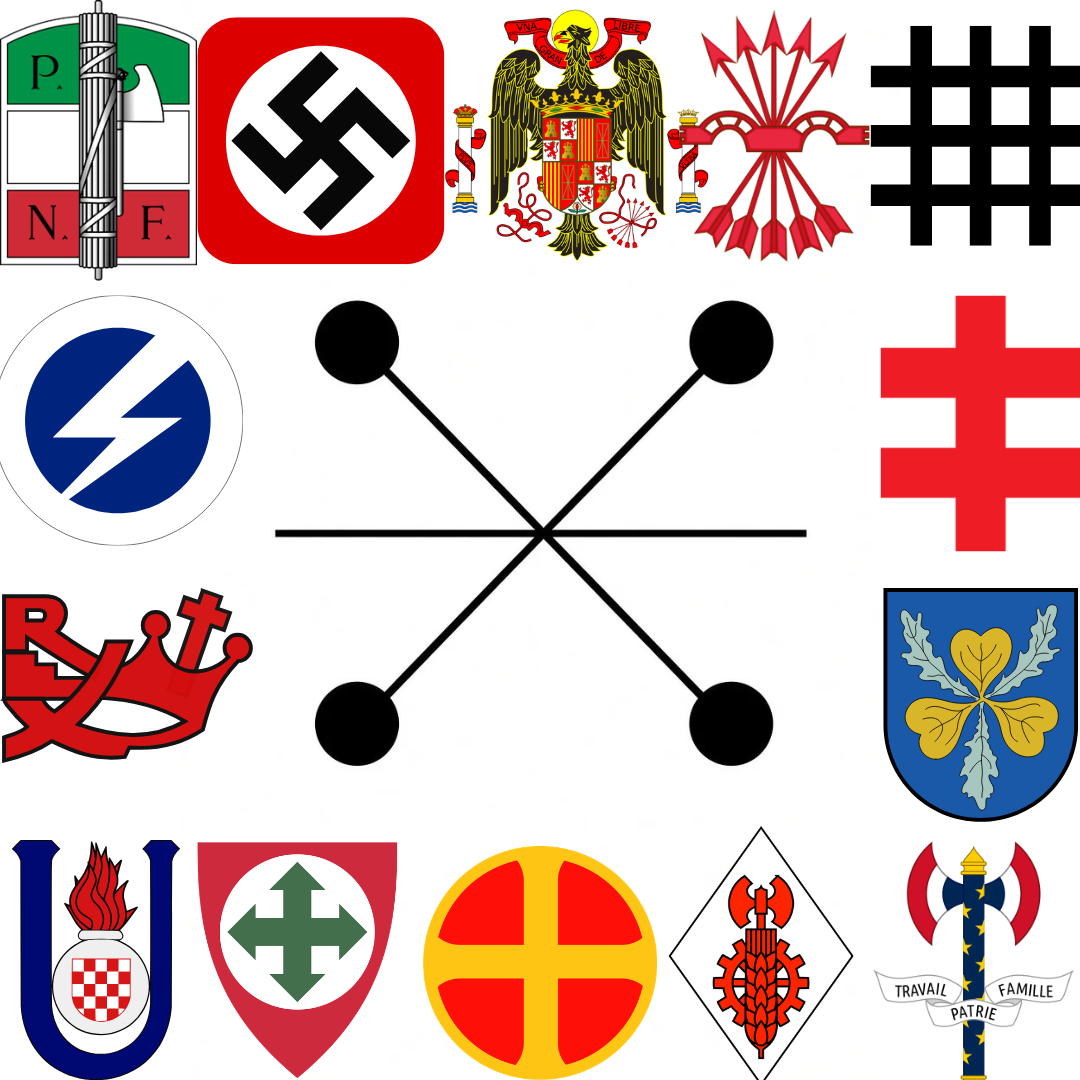
The Donnite ideology is primarily drawn from fifteen existing ideologies. These are, in no particular order: Classical Fascism, National Socialism, Francoism, Falangism, Legionarism, Mosleyism, Rexism, Ustašism, Hungarism, Quislingism, Francisme, Vichyism, Bismarckism, Clerical Fascism, and Third Positionism. Here I shall explain the direct inspirations upon which Donnism draws, and how it merges them into one coherent ideology.
Be aware that Donnism is not drawn entirely from existing theory. This essay is not intended to explain the original ideas unique to Donnism, but rather the existing ideas it upholds and abides by. Overarching similarities among all ideologies, such as authoritarianism, may not be mentioned in each part. This does not mean the inspiration is not present in Donnism, it merely means it isn’t worth repeating.
As Benito Mussolini and Giovanni Gentile write in The Doctrine of Fascism, “It is quite logical for a new doctrine to make use of the still vital elements of other doctrines. No doctrine was ever born quite new and bright and unheard of. No doctrine can boast absolute originality. It is always connected, if only historically, with those which preceded it and those which will follow it.”
Donnism recognizes that the desire for total originality and separation from pre-existing ideas is a direct result of individualism, and therefore must be rejected and opposed entirely. Upon the foundation of great movements before us is Donnism built; and the noble legacies of those great leaders shall it uphold.
Part 1 – Classical Fascism
Classical Fascism was conceived by Benito Mussolini around 1919 and later defined with the assistance of Giovanni Gentile in the late 1920s and early 1930s. It was the official ideology of Fascist Italy from 1922 to 1943 and continued in the Italian Social Republic from 1943 to 1945.
From Classical Fascism, Donnism draws its primary emphasis on the absolute leadership principle and the complete rejection of any separation of powers. The abolition of parliamentary democracy is taken as essential, for strength in unity must always stand above the instability of democratic process. State Corporatism is adopted as the official economic policy of Donnism in a form closely modeled on what Classical Fascism first put into practice.
Mussolini’s maxim—“Everything within the State, nothing outside the State, nothing against the State”—is accepted as a core Donnite principle. The ethical primacy of the State over the individual, the rejection of both liberalism and Marxism, and the priority given to action, hierarchy, and national rebirth are all foundational points shared by the two ideologies.
In summary, Classical Fascism is one of the most essential sources upon which Donnism is built. Benito Mussolini remains one of the most influential figures in this tradition, and Donnism vows to carry his legacy forward.
Part 2 – National Socialism
National Socialism was formally established in 1920 under Adolf Hitler and further defined by men such as Alfred Rosenberg and Gottfried Feder. It was the governing ideology of Germany during the Third Reich from 1933 to 1945.
Donnism takes from National Socialism the core ideas of racial hierarchy and demographic priority, treating the survival and advancement of the White race as a moral good of the highest order. The total subordination of the individual to the collective national body is embraced as both necessary and natural. The Jew is viewed as an enemy to be opposed and excluded, for the synagogue of Satan and its works cannot be allowed to stand.
Expansionism is accepted, together with the militarization of youth and society for the sake of security and the greater good. The imperial ambition of Donnism is absolute and shares clear continuity with the vision advanced by National Socialism. The unification of culture, ideology, and nation is likewise admired and taken as a model.
In conclusion, the influence of National Socialism’s racial hierarchy and totalitarian mobilization upon Donnite principle cannot be overstated. Adolf Hitler is regarded as a martyr for the broader Cause, and the Third Reich is viewed as one of the closest historical approximations to ordered national greatness.
Part 3 – Francoism
Francoism was the governing system and ideological orientation of Francisco Franco, who ruled Spain from 1939 to 1975. Though it was institutionalized after the Nationalist victory in 1939, its roots lie in the Spanish Civil War that began in 1936. While it drew heavily upon Falangism, Franco himself was not a pure Falangist, and the two remain distinct.
The most immediate similarity between Donnism and Francoism is the fusion of authoritarian rule with Christian traditionalism. Donnism places absolute submission of life before God and therefore aligns closely with the religious foundation Franco established. It draws from Francoism the model of a durable, traditionalist-authoritarian regime that preserves religious identity while systematically crushing leftist and liberal opposition.
Anti-communism, hierarchical social order, and a national Christian framework are treated as non-negotiable in both. The long-term stability Franco achieved while keeping Spain oriented toward the Faith is regarded as a practical demonstration of what ordered Christian authority can accomplish.
In summary, Francoism’s religious outlook and traditional policies are heavily drawn upon by Donnism. Francisco Franco is honored as a foremost defender of Christian civilization against Marxist subversion.
Part 4 – Falangism
Falangism was created by José Antonio Primo de Rivera in 1933, with contributions from Rafael Sánchez Mazas, Onésimo Redondo, Ramiro Ledesma Ramos, and others. It heavily influenced later Francoist Spain while remaining distinct in important respects, and it was never fully enacted as the sole governing system of a nation in its pure form.
Donnism accepts Falangism’s explicit Third Way rejection of both parliamentary liberalism and Marxist class struggle. The emphasis on service, sacrifice, and a unified national destiny is embraced without reservation. The poetic-militant style of commitment that marked the early Falange also carries significant influence.
The sense of brotherhood cultivated within the movement is recognized by Donnism as something of lasting value. Cultural seriousness and the demand that the individual find meaning only in service to a great collective task are taken as enduring lessons.
In closing, Falangism’s Third Way orientation and cultural seriousness are indispensable to Donnism. José Antonio Primo de Rivera is remembered as a great man whose example continues to instruct.
Part 5 – Legionarism
Legionarism was founded in 1927 by Corneliu Zelea Codreanu through the Legion of the Archangel Michael, later known as the Iron Guard. Nae Ionescu and others contributed to its later refinement. Though it never fully governed Romania, it became one of the most dynamic and influential political forces in the country during the 1930s.
The most defining inspiration Donnism draws from Legionarism is the intense fusion of Christianity with national and personal life. Legionarism placed Christ and the Faith above all else; Donnism does the same. From the Legion is inherited the understanding that political struggle is simultaneously a spiritual crusade.
The movement itself is treated as a sacred community bound by faith and total loyalty. Ascetic discipline, sacrificial brotherhood, and the refusal to separate the political from the spiritual are all taken as essential.
In essence, Legionarism supplies Donnism with the clearest model of a militant Christian nationalism in which the Cause and the Faith are one. Corneliu Zelea Codreanu is honored as a pure and uncompromising martyr of that vision.
Part 6 – Mosleyism
Mosleyism is the ideology of Sir Oswald Mosley, founder and leader of the British Union of Fascists. It was never enacted as a governing system in any nation, yet its influence upon Western Fascism and Third Position thought remains substantial.
Mosleyism’s corporatist economic approach, its anti-democratic nationalism, and its sharp critique of parliamentary decay are all key inspirations for Donnism. The emphasis on authority, order, and national discipline is taken over directly. Its vision of broader coordination among kindred European movements is also present, though Donnism reframes this as White racial and civilizational unity.
Mosley’s willingness to recognize common ground with National Socialism, Classical Fascism, Francoism, and related currents further aligns with Donnism’s own selective synthesis. The refusal to abandon the Cause after 1945 is regarded as especially instructive.
Sir Oswald Mosley and his ideas remain worthy of respect and continued study. He is remembered as a man who kept the Fascist standard alive in the Anglo world when few others would.
Part 7 – Rexism
Rexism was the movement and ideology associated with Léon Degrelle and the Rexist Party in Belgium, emerging in the mid-1930s. It never governed Belgium as a whole, but after 1940 Degrelle committed the movement fully to the European struggle, leading Walloon volunteers on the Eastern Front.
Donnism draws from Rexism the example of a Christian-oriented authoritarian nationalism willing to place itself within a larger continental effort against communism and liberal decay. The combination of corporatist ideas, anti-parliamentary populism, and militant anti-Bolshevism is taken as valuable. Degrelle’s personal trajectory—from political leader to front-line combatant—embodies the kind of total commitment required.
His refusal to recant after 1945 and his continued advocacy for the mission reinforce the principle that military defeat does not dissolve duty to the Cause. Lifelong fidelity under persecution is treated as a standard, not an exception.
In this respect Rexism supplies both a political model and a personal example. Léon Degrelle is honored as a soldier of the larger European revolution who never surrendered his convictions.
Part 8 – Ustašism
Ustašism was the revolutionary nationalist movement led by Ante Pavelić that established the Independent State of Croatia in 1941 and held power until 1945. It pursued a radical program of national independence under wartime conditions.
Donnism takes from Ustašism the willingness to employ decisive and, when necessary, severe measures in order to secure national survival and religious-cultural continuity. The fusion of militant nationalism with Christian loyalty is recognized as a serious attempt to defend a people and a faith against multiple enemies. The refusal to accept permanent subjugation to larger hostile powers aligns with Donnism’s own insistence on demographic and spiritual self-preservation.
Pavelić’s later exile and continued political activity illustrate that the struggle does not end with the loss of territory. The movement’s severity is understood as a response to the extremity of the situation it faced.
Ante Pavelić is remembered as a leader prepared to do what the survival of his people required. His example is taken as one of resolve rather than compromise.
Part 9 – Hungarism
Hungarism was the ideology of Ferenc Szálasi and the Arrow Cross movement. It briefly governed Hungary from October 1944 to March 1945 in the final phase of the war, under conditions of extreme pressure.
Donnism draws from Hungarism the example of uncompromising will in the face of impending defeat. The rejection of half-measures and the insistence that the nation must be regenerated according to a clear hierarchical and anti-liberal vision—even when material prospects are poor—are taken as instructive. Social discipline and the demand that none live off the labor of others without contributing are also noted.
Szálasi’s refusal to abandon the alliance or his principles under impossible conditions is treated as a demonstration of unbroken loyalty. The short duration of his rule does not diminish the clarity of the standard he set.
Ferenc Szálasi is honored as a man who kept faith with his vision when almost every outward advantage had already been lost.
Part 10 – Quislingism
Quislingism refers to the authoritarian nationalist project associated with Vidkun Quisling and Nasjonal Samling in Norway. It exercised governmental authority in Norway from 1942 until 1945 in cooperation with German forces.
Donnism regards Quisling’s effort as an attempt to secure national continuity through alignment with the broader European new order directed against Bolshevism and international finance. The choice to work within the dominant continental power rather than cling to democratic or liberal alternatives is seen as a serious strategic decision.
Anti-communist and anti-Jewish elements of the program are noted as points of continuity.
The postwar vilification of Quisling’s name is rejected as the judgment of the victors. What remains relevant is the principle of placing the long-term regeneration of Europe above short-term national isolation or democratic purity.
Vidkun Quisling is remembered as a Norwegian leader who chose the harder path in service of a larger Cause. His reputation is to be recovered from the propaganda that buried it.
Part 11 – Francisme
Francisme was the French Fascist movement founded by Marcel Bucard in 1933. A decorated veteran of the Great War, Bucard sought a national revolution that would restore French greatness. The movement was banned in 1936, revived after 1940, and never fully governed France.
Donnism takes from Francisme the model of a combat-oriented, anti-parliamentary French nationalism willing to align itself with the larger European authoritarian wave. The emphasis on authority, discipline, and the rejection of parliamentary and class-based decay is accepted. Bucard’s persistence after earlier suppression demonstrates the required refusal to abandon the field.
His wartime collaboration and his conduct at the end—facing execution in 1946 without renouncing his positions—exemplify the standard of loyalty Donnism demands. The final affirmation of France even in defeat is noted with respect.
Marcel Bucard is honored as a French soldier and Fascist who kept faith to the last.
Part 12 – Vichyism
Vichyism designates the National Revolution undertaken by the French State under Marshal Philippe Pétain after the armistice of 1940. It governed the unoccupied zone of France and attempted a broader moral and institutional reconstruction until the Allied invasion.
Donnism draws from Vichy the concrete attempt to regenerate a defeated nation through authoritarian moral order rather than through a return to liberal democracy. The motto “Work, Family, Fatherland” and the emphasis on hierarchy, soil, familial duty, and the exclusion of corrosive influences are taken as serious efforts at national recovery. Corporatist economic leanings and traditionalist social policy further align with Donnite priorities.
The decision to end a pointless war and turn inward toward reconstruction is treated as a realistic act of statecraft under imperfect conditions. The limitations imposed by the measures of the war do not erase the value of the internal program that was enacted.
Philippe Pétain is remembered as the marshal who sought to save what could still be saved of France when the Third Republic had already failed.
Part 13 – Bismarckism
Bismarckism refers to the authoritarian statecraft of Otto von Bismarck, who unified Germany through a series of limited wars and then served as first Chancellor of the German Empire from 1871 to 1890. It was fully enacted in the institutions of the Second Reich.
Donnism takes from Bismarck the older precedent of national consolidation through strong, hierarchical authority rather than liberal debate or majority votes. The maxim that great questions are decided by iron and blood is accepted as a realistic assessment of political life. The creation of a powerful, centralized state that stands above factional politics remains a foundational reference.
Bismarck’s combination of domestic authoritarianism with sophisticated diplomacy that preserved peace for a generation is also noted. The model of a state that pursues national interest with firmness and without parliamentary illusion continues to instruct.
Otto von Bismarck is honored as the outstanding modern example of state-building in the service of national power and order.
Part 14 – Clerical Fascism
Clerical Fascism, in the form most relevant to Donnism, was realized in the Slovak State under President Jozef Tiso from 1939 to 1945. Tiso, an ordained Catholic priest, led an authoritarian national regime that made Christianity a public and guiding force via political control and order.
Donnism draws from Tiso’s Slovakia the principle that Christian faith must not be privatized or subordinated to secular liberalism. At the same time, political authority itself belongs to the organized national leadership. The result is a system in which Christian moral order informs law and culture while the State remains the decisive instrument of power. This balance—faith as the foundation, political leadership as the directing will—is treated as essential.
The Slovak example demonstrated that a small nation could maintain authoritarian order, national independence, and a public Christian character in alliance with larger kindred forces. Anti-communism, hierarchical discipline, and the defense of traditional religious identity against liberal and Marxist pressure are all taken as points of continuity.
In summary, the Slovak State under Jozef Tiso supplies Donnism with the clearest historical model of clerical-authoritarian governance. Tiso is honored as a priest-statesman who showed that authentic Christian order and national authoritarian politics can reinforce one another.
Part 15 – Third Positionism
Third Positionism, in the form most foundational to Donnism, was articulated with particular clarity by Arthur Moeller van den Bruck. In his 1923 work Das Dritte Reich and related writings, Moeller called for a future German order that would reject both Western liberalism and Marxism, transcending the failures of the old conservative elites and the Weimar Republic. Though never enacted as a governing system in his lifetime, his ideas strongly influenced the broader conservative-revolutionary and National Socialist milieu. Later expressions of the same orientation appeared in various forms, most notably in the Justicialist government of Juan Perón in Argentina.
Donnism adopts from Moeller the explicit rejection of both liberal capitalism and Marxism in favor of a nationalist, hierarchical alternative. He insisted that the nation required a new spiritual and political form beyond the materialist systems of the age. This refusal of the false choice between international finance and international communism is taken as a defining stance. The call for a third way that would restore organic national order remains central.
The same basic orientation was later given practical expression by Juan Perón, who explicitly described his movement as a Third Position and sought to raise living standards, assert national sovereignty, and refuse subordination to either capitalist or communist blocs. Perón’s government demonstrated that the rejection of both materialist internationalisms could be pursued in power and could provide refuge to European comrades after 1945. Donnism recognizes this continuity while still regarding Moeller’s theoretical clarification as the more foundational contribution.
In this light, Arthur Moeller van den Bruck is remembered as a decisive forerunner who first gave clear intellectual form to the necessity of a path beyond capitalism and Marxism. Juan Perón and other later practitioners are honored as those who carried the same orientation into the realm of state power. Donnism upholds the entire line of Third Position belief as core and absolute in its own ideological stance.
Closing
These fifteen sources do not exhaust the historical record, nor does Donnism claim to be a simple average of them. It selects, intensifies, and subordinates their still-vital elements to a stricter Biblical standard and a more absolute rejection of individualism and free will than most of them maintained. The result is a single, coherent ideology that stands on the shoulders of its predecessors while refusing the errors and incompleteness that limited them. The work of synthesis is not an act of originality for its own sake; it is the necessary continuation of a struggle that did not end in 1945.